KV Cache
The problem: recomputing the same information
LLMs generate text one token at a time. Ask for Tell me a story about dragons and the model produces its answer token by token:
Once
Once upon
Once upon a
Once upon a time
...
Every new token depends on all previous tokens. Without a KV cache, the model would repeatedly recompute information for tokens it has already processed:
Step 1
Input: "Hello"
→ Compute attention over [Hello]

Step 2
Input: "Hello world"
→ Compute attention over [Hello, world]
→ "Hello" is computed again

Step 3
Input: "Hello world today"
→ Compute attention over [Hello, world, today]
→ "Hello" and "world" are computed again
Notice something? The word "Hello" never changes, yet we keep recomputing it every time a new token is generated. As the conversation grows longer, this repeated computation becomes increasingly expensive.
What happens inside attention?
Every token is converted into three vectors: a Query (Q) — what information is this token looking for; a Key (K) — what information does this token provide; and a Value (V) — the actual information that will be used if another token attends to it.
Think of it like a library: Query is the question you're asking, Key is the labels on every book, and Value is the contents of each book. The model compares the Query with all the Keys to decide which Values are most relevant.
The expensive part
For every token generated, the model must compute Q, K, and V. The problem is that Keys and Values for old tokens never change — so why recompute them?
Token 1 → K1, V1
Token 2 → K2, V2
Token 3 → K3, V3
Instead of recalculating these every decoding step, we simply save them.
What gets cached?
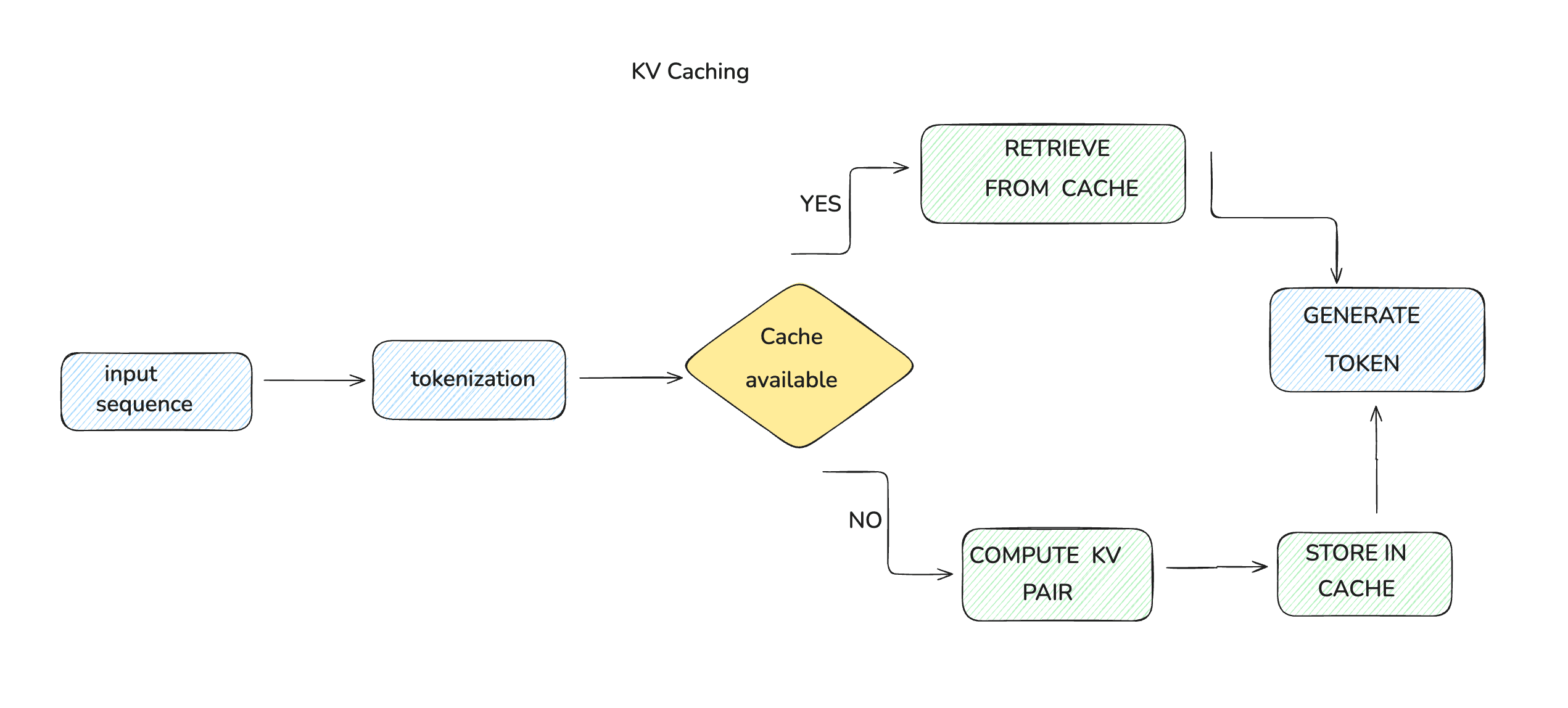
The model stores all previously computed Keys and Values — this is called the KV cache.
Cache

K = [K1, K2, K3]
V = [V1, V2, V3]
What happens when a new token arrives?
Suppose token 4 is generated. Instead of recomputing K1, K2, K3 and V1, V2, V3, the model only computes Q4, K4, and V4, then appends the new Key and Value to the cache:
K = [K1, K2, K3, K4]
V = [V1, V2, V3, V4]
Finally, Q4 attends over every Key in the cache — Q4 compares against K1..K4, retrieves the relevant Values, and predicts the next token. Notice that K1–K3 and V1–V3 were never recomputed.
Why don't we cache Queries?
A common question: why do we only cache K and V — why not Q? Because the Query belongs to the current token only. When generating token 4, Q4 is completely different from Q3 — every newly generated token asks a new question about the previous context, so Queries must always be computed again. Keys and Values, however, describe past tokens, which never change once generated.
Architecture Diagram
Why is KV cache so fast?
Imagine reading a 500-page book.
- Without a KV cache — every time you finish a new page, you start again from page 1: read page 1, page 2, restart, page 1, page 2, page 3, restart. You spend most of your time rereading old pages.
- With a KV cache — you remember everything you've already read: read pages 1–500, store them in memory, then read only page 501. No unnecessary rereading.
Exactly the same idea applies to LLM inference.
Why this matters
Without a KV cache, every decoding step would repeat work for the entire sequence — as the prompt grows longer, there are more previous tokens, more repeated computation, and slower generation. With a KV cache, previous Keys and Values are reused, only the newest token requires fresh computation, and generation becomes dramatically faster.
The trade-off
KV cache speeds up inference, but it isn't free. The cache grows with the number of generated tokens — more tokens means more Keys, more Values, and more GPU memory. If you're serving many users simultaneously, every request maintains its own KV cache, which can consume a significant amount of GPU memory.
Because of this, modern inference systems use techniques such as:
- PagedAttention — stores the KV cache efficiently
- KV cache eviction — removes old entries when appropriate
- KV cache compression/quantization — reduces memory usage
These optimizations help maintain high throughput while keeping memory usage manageable.
Quick summary
- Every token creates Query (Q), Key (K), and Value (V) vectors.
- Queries are recomputed every decoding step because each new token asks a new question.
- Keys and Values never change once created, so they are stored in the KV Cache.
- When generating a new token, the model computes only the new Q, K, and V, then reuses all previously cached K and V.
- Benefit: Much faster text generation because redundant computations are avoided.
- Trade-off: KV Cache grows with sequence length and consumes GPU memory.
One-line takeaway: KV Cache trades GPU memory for speed—it stores previously computed Keys and Values so the model doesn't have to recompute them for every new token.